The global market for mobile gaming is projected to experience robust growth, expanding from a valuation of USD 139.38 billion in 2024 to an impressive USD 256.19 billion by 2030. This growth trajectory represents a Compound Annual Growth Rate (CAGR) of 10.2% over the forecast period from 2025 to 2030.
As we are stepping into 2024, the mobile gaming industry continues to exhibit extraordinary growth, building upon the momentum gained in recent years. The segment has not only withstood the challenges of the COVID-19 pandemic but has also capitalized on them, evolving into a more robust and expansive sector. This growth trajectory has been fueled by a continuous increase in smartphone penetration and the global advancement of high-speed internet services, including the widespread adoption of 5G technology.
The years 2022 and 2023 have been particularly pivotal. In 2023, the industry saw an unprecedented surge in user engagement and market expansion. Key markets, including China, the United States, Japan, South Korea, and emerging players like India, have shown remarkable growth. China maintained its lead with an impressive market size, exceeding $40 billion, reflecting a consistent upward trend from the $29 billion mark in 2021. This growth can be attributed to a combination of factors, including the country’s robust digital infrastructure and the deep integration of mobile gaming into social and entertainment lifestyles.
Top 6 countries & regions in the mobile gaming market segment 2023
Here is the list of the top 6 countries & regions in the mobile gaming market segment.
- China
- United States
- Europe
- Japan
- South Korea
- India
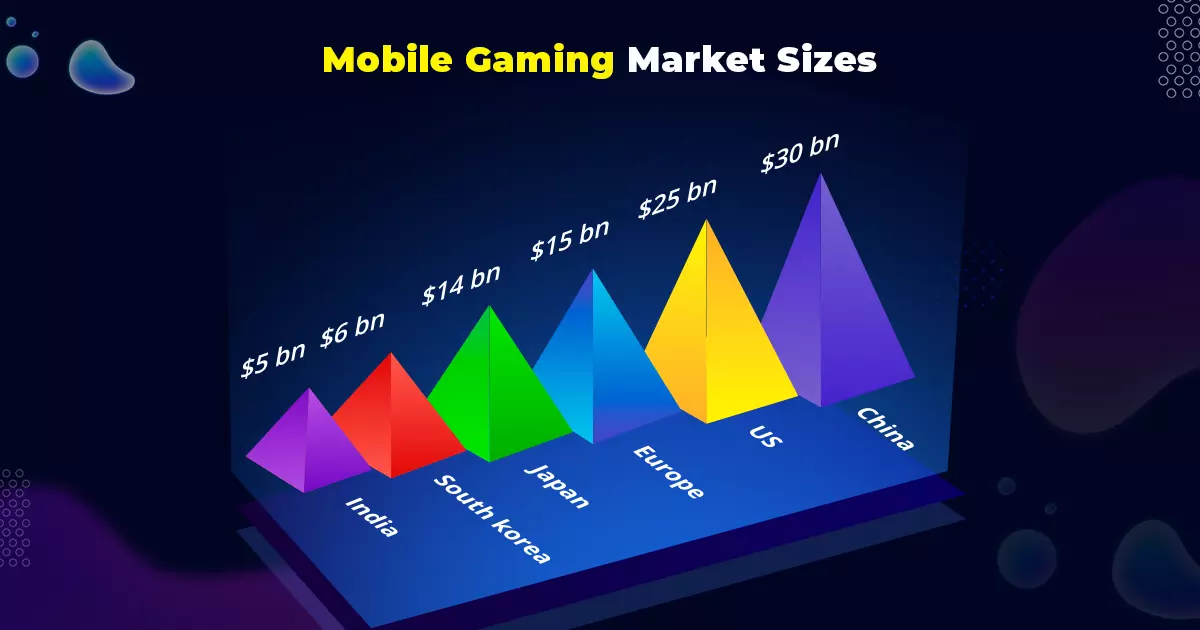
- China Market (2023): Market value estimated at over $40 billion.
- Key Chinese Companies (2023): Dominant players include Tencent, NetEase, miHoYo, and Lilith Games.
- Global Market Leaders (2023): Top markets are China, the United States, Japan, South Korea, and India.
- United States Market Size (2023): Estimated at around $22 billion.
- Japan’s Mobile Gaming Market (2023): Valued at approximately $14 billion.
- South Korea’s Market Size (2023): Around $5 billion, with a focus on eSports and strategy games.
- India’s Market Growth (2023): Rapidly expanding, reaching about $6 billion.
In the dynamic landscape of mobile gaming, the market size varies significantly across countries, reflecting cultural preferences, economic factors, and technological access.
1. China: A Giant in Mobile Gaming
- Market Size: Around $40 billion in 2023.
- Key Fact: Mobile gaming accounts for nearly 70% of the country’s total gaming revenue.
- Regulatory Impact: Stricter regulations have led to a more controlled but still thriving gaming environment.
China’s market is immense, with a strong preference for multiplayer and RPGs, reflecting the social aspect of gaming in the country. China’s mobile gaming market rivalling the US in terms of revenue and player base. Unique in its gaming culture, China sees a predominance of multiplayer and role-playing games. Government regulations, however, play a significant role in shaping the industry, with strict controls over game content and licensing.
2. United States: The Pinnacle of Mobile Gaming
- Market Size: Estimated at $22 billion in 2023.
- Key Fact: Over 60% of smartphone users play mobile games.
- Trend: There’s a growing interest in AR and VR mobile games.
The U.S. stands as a titan in the mobile gaming industry, driven by technological innovations and a culture that embraces digital entertainment. The United States has consistently been a frontrunner in the mobile gaming sector. With a market size surpassing billions, it’s a hub for technological innovation and high consumer spending. Factors contributing to this dominance include widespread smartphone usage, high disposable incomes, and a strong gaming culture. Popular genres include strategy, puzzle, and adventure games, catering to a diverse audience.
3. Europe: A Diverse Gaming Landscape
- Market Size: Collectively around $22 billion in 2023.
- Key Fact: Diverse gaming preferences, with a strong inclination towards puzzle and strategy games.
- Regulatory Trend: Leading in player protection regulations.
Europe’s mobile gaming market has diverse cultures reflected in its gaming trends, with different countries favouring different genres, all under a regulatory environment prioritizing player safety. Countries like the UK, Germany, and France show strong market sizes, with preferences varying from adventure and strategy games to casual puzzles. The European market is also a leader in adopting regulatory measures for player protection, like those addressing in-game purchases and advertising.
4. Japan: The Land of Mobile RPGs
- Market Size: Approximately $14 billion in 2023.
- Key Fact: Mobile games contribute to over 50% of the total gaming revenue in Japan.
- Unique Trend: High player loyalty to RPG franchises.
Japan’s mobile gaming market is notable for its love for role-playing games (RPGs), indicating a deep-rooted affection for story-driven and character-centric games. The market is characterized by high player engagement and spending, despite a smaller population compared to China and the US. Japanese players are known for their loyalty to franchises and characters, driving the success of both domestic and international RPG titles.
5. South Korea: The Epicenter of Competitive Gaming
- Market Size: Estimated at $5 billion in 2023.
- Key Fact: Over 65% of the population engages in mobile gaming.
- Cultural Aspect: A strong eSports culture, with a focus on strategy and MOBA games.
In South Korea, mobile gaming is not just entertainment; it’s a competitive sport. With a strong inclination towards strategy and MOBA (Multiplayer Online Battle Arena) games, the South Korean market is a leader in eSports. South Korea’s advanced internet infrastructure and a culture embracing competitive gaming make it a unique player in the mobile gaming realm.
6. India: A Rapidly Growing Market
- Market Size: Expected to reach $5 billion by 2023.
- Key Fact: Smartphone gaming users have increased by 50% in the last two years.
- Trend: A surge in hyper-casual and social gaming.
India’s mobile gaming market rapidly growing market, driven by affordable internet and smartphone accessibility, which presents vast opportunities for game developers. The market is diverse, with a preference for hyper casual and social games. This growth presents a significant opportunity for both local and international game developers.
Take Away
As we are in 2024, the mobile gaming industry shows no signs of slowing down. The trends of the previous years are not only continuing but also evolving with the introduction of new gaming genres, innovative monetization models, and the integration of advanced technologies like augmented reality (AR) and virtual reality (VR). These technological advancements are not just enhancing the gaming experience but are also attracting a wider, more diverse audience to the world of mobile gaming.
Furthermore, the industry is witnessing a significant shift in strategy, particularly in the approach to game development and distribution. Companies are increasingly focusing on cross-platform compatibility, ensuring that mobile games are accessible on a variety of devices, thereby expanding their user base. The free-to-play model, complemented by in-app purchases and advertising, continues to be a successful strategy, especially for new entrants looking to establish a foothold in this competitive market.
This dynamic period is also marked by the rise of new players in the industry, both in terms of game developers and emerging markets. Countries like India are rapidly climbing the ranks in the mobile gaming sector, driven by a massive young population and increasing digital connectivity. With innovative approaches and continuous growth, the mobile gaming sector is poised to redefine entertainment and connectivity in the digital era.